
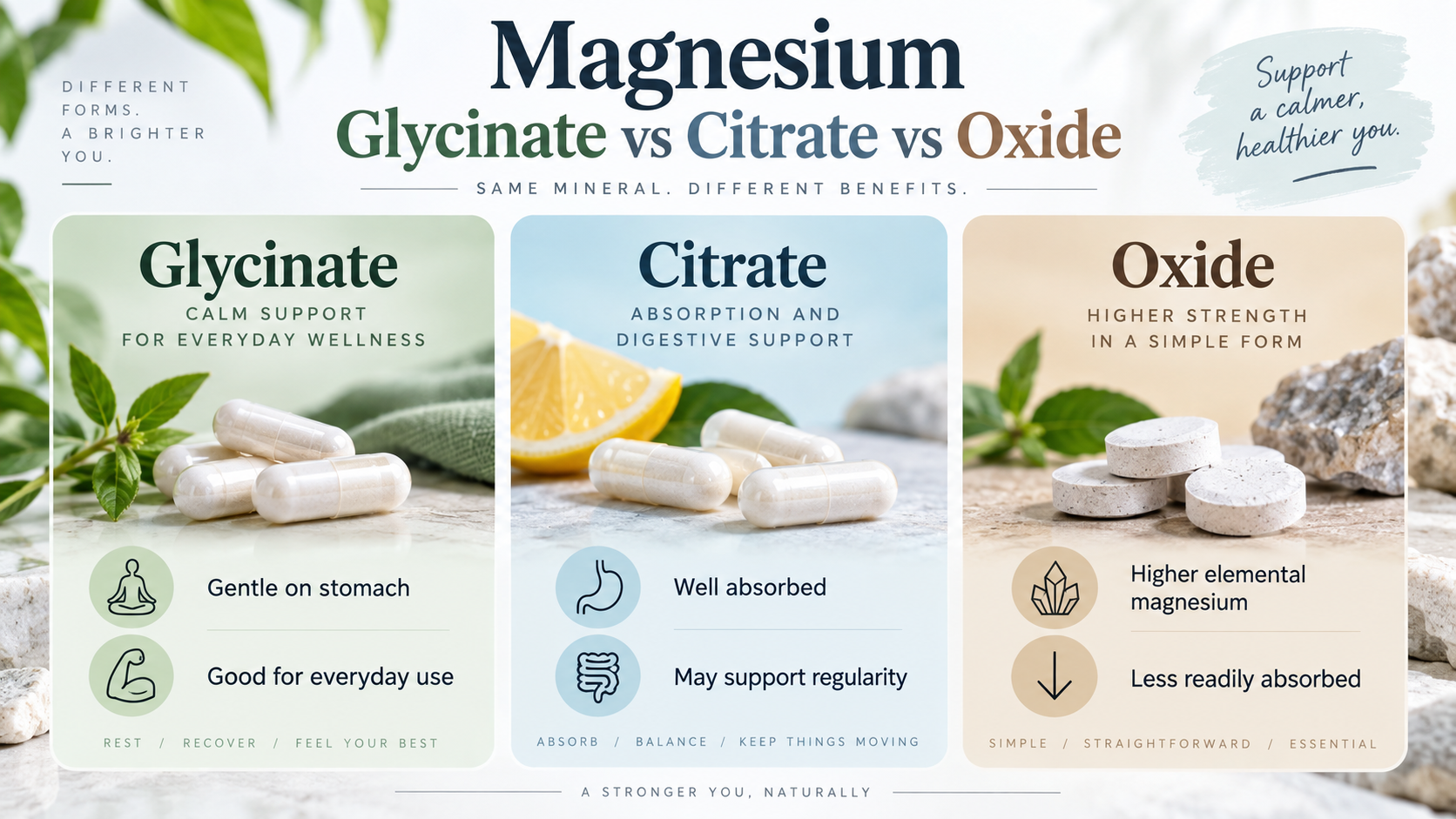
Magnesium Glycinate vs Citrate vs Oxide: Which Type Is Right for You?
Magnesium is an essential mineral involved in hundreds of processes throughout the body. It contributes to normal muscle and nerve function, energy production, blood sugar regulation, blood pressure, bone health and the production of DNA and protein.
But shopping for magnesium can quickly become confusing. Supplement labels may say magnesium glycinate, magnesium citrate, magnesium oxide, magnesium malate, magnesium aspartate or something else entirely.
The form matters because different magnesium compounds contain different amounts of elemental magnesium and may differ in absorption and digestive effects.
This guide compares three of the most common forms: magnesium glycinate vs citrate vs oxide.
Why Does Your Body Need Magnesium?
Magnesium is an essential nutrient, which means the body cannot make it and must obtain it through food or supplements.
Magnesium contributes to:
- Normal muscle contraction and relaxation
- Nerve signaling
- Energy production
- Blood glucose regulation
- Normal blood pressure
- Bone structure
- Protein production
- DNA and RNA synthesis
- Normal heart rhythm
Foods containing magnesium include nuts, seeds, legumes, whole grains and leafy green vegetables.
How Much Magnesium Do Adults Need?
Recommended magnesium intake varies by age and sex.
For most adults, the recommended daily amount from all sources is approximately:
- Adult men: 400 to 420 mg per day
- Adult women: 310 to 320 mg per day
- Pregnancy: requirements generally increase
These recommendations refer to total magnesium from food, beverages and supplements—not the amount a person necessarily needs to take as a supplement.
What Does “Elemental Magnesium” Mean?
This is one of the most important things to understand when comparing supplements.
Magnesium must be attached to another substance to form a stable supplement ingredient. For example, magnesium citrate combines magnesium with citric acid, while magnesium glycinate combines magnesium with the amino acid glycine.
The number on the front of the bottle may describe the entire compound, but the Supplement Facts panel tells you how much actual, or elemental, magnesium the serving provides.
Always compare products using the amount of elemental magnesium rather than simply comparing the weight of the magnesium compound.
Magnesium Glycinate
Magnesium glycinate, sometimes called magnesium bisglycinate, combines magnesium with the amino acid glycine.
Why Do People Choose Magnesium Glycinate?
Magnesium glycinate is popular because it is generally considered a stomach-friendly form of magnesium and is less likely than some forms to produce a strong laxative effect.
It is frequently marketed for:
- General magnesium supplementation
- Muscle relaxation
- Evening use
- People who experience digestive upset with other forms
Although magnesium is important for normal nervous-system and muscle function, claims that magnesium glycinate specifically acts as a sleep treatment go beyond current evidence.
Who May Prefer Magnesium Glycinate?
Someone who wants magnesium supplementation without a significant bowel effect may prefer glycinate.
It may also be useful for people who find magnesium citrate or oxide too laxative.
Magnesium Citrate
Magnesium citrate combines magnesium with citric acid.
It is one of the better-absorbed forms documented in nutritional research and is commonly used in dietary supplements.
Why Do People Choose Magnesium Citrate?
Magnesium citrate can provide supplemental magnesium while also drawing water into the intestines.
Because of that effect, it is frequently used by people who also want support for occasional constipation.
Its digestive effect can be either an advantage or disadvantage depending on the individual.
Who May Prefer Magnesium Citrate?
Magnesium citrate may be a practical choice for someone who wants a readily absorbed magnesium form and does not mind—or specifically wants—a mild laxative effect.
Magnesium Oxide
Magnesium oxide combines magnesium with oxygen.
It contains a relatively high percentage of elemental magnesium by weight, which allows manufacturers to provide a substantial listed amount in a small tablet or capsule.
However, magnesium oxide is generally less readily absorbed than forms such as citrate.
Why Is Magnesium Oxide Common?
Magnesium oxide is inexpensive, widely available and contains a high concentration of elemental magnesium.
It is also frequently found in antacids and laxative products because unabsorbed magnesium can remain in the digestive tract and attract water.
Who May Prefer Magnesium Oxide?
It may be appropriate in some formulations, particularly when digestive effects are desired, but people primarily focused on magnesium absorption may prefer another form.
Magnesium Glycinate vs Citrate vs Oxide: Quick Comparison
| Type | Common Reason People Choose It | Digestive Effect | Key Consideration |
|---|---|---|---|
| Magnesium Glycinate | General supplementation, stomach tolerance | Usually gentler | Popular when laxative effects are not wanted |
| Magnesium Citrate | Magnesium supplementation plus bowel support | May loosen stools | Generally well absorbed |
| Magnesium Oxide | Inexpensive magnesium or bowel support | More likely to have laxative effects | Generally less readily absorbed |
Which Magnesium Is Best for Sleep?
Magnesium has become popular in nighttime supplements because it plays an important role in normal nerve and muscle function.
Magnesium glycinate is often marketed for evening use because it tends to be gentle on the digestive system and includes glycine.
However, research does not establish one magnesium form as a universal sleep treatment.
If poor sleep is caused by a magnesium deficiency, correcting inadequate intake may help overall health. Persistent insomnia should be evaluated rather than treated solely with supplements.
Which Magnesium Is Best for Constipation?
Magnesium citrate is commonly used when a bowel effect is desired because it draws water into the intestines.
Magnesium oxide may also have a laxative effect.
Magnesium glycinate is generally less likely to loosen stools and therefore may be preferred when constipation relief is not the goal.
Which Magnesium Is Best for Muscle Support?
Magnesium itself is important for normal muscle contraction, relaxation and nerve signaling.
For routine magnesium supplementation, the most important factors are usually:
- How much elemental magnesium the product contains.
- How well you tolerate it.
- How readily the form is absorbed.
- Whether you want or wish to avoid a laxative effect.
No single magnesium form is universally best for every person.
Other Types of Magnesium
Glycinate, citrate and oxide are only three of many magnesium forms.
You may also see:
- Magnesium aspartate
- Magnesium chloride
- Magnesium lactate
- Magnesium malate
- Magnesium taurate
- Magnesium threonate
- Magnesium ascorbate
Discount Remedies carries several magnesium-containing formulas, including NOW Foods Magnesium & Potassium Aspartate with Taurine and Source Naturals Magnesium Ascorbate.
Can You Take Too Much Magnesium?
Magnesium from food generally does not cause problems in healthy people because the kidneys help remove excess amounts.
High doses of supplemental magnesium, however, can cause:
- Diarrhea
- Nausea
- Abdominal cramping
Extremely high magnesium intake can become dangerous, particularly in people whose kidneys cannot remove magnesium efficiently.
Magnesium and Kidney Disease
People with significant kidney disease should not begin high-dose magnesium supplementation without medical guidance.
The kidneys normally regulate magnesium levels. Reduced kidney function can allow magnesium to accumulate in the bloodstream.
Magnesium Medication Interactions
Magnesium can interfere with the absorption of several medications.
Important examples include certain:
- Antibiotics
- Bisphosphonates used for osteoporosis
- Diuretics
- Long-term acid-reducing medications
Some medications need to be separated from magnesium supplements by several hours.
A pharmacist can tell you whether your medication should be taken at a different time from magnesium.
How to Choose a Magnesium Supplement
When comparing products, look for:
- The form of magnesium.
- The amount of elemental magnesium per serving.
- The number of capsules or tablets required per serving.
- Whether you want or want to avoid a laxative effect.
- Additional ingredients such as calcium, potassium or vitamin D.
- Your medications and health conditions.
Magnesium Frequently Asked Questions
Which magnesium is easiest on the stomach?
Magnesium glycinate is commonly chosen because it tends to cause fewer laxative effects than citrate or oxide. Individual tolerance varies.
Which magnesium is best absorbed?
Research indicates that forms including magnesium citrate, chloride, lactate and aspartate tend to be absorbed more readily than magnesium oxide. Absorption also depends on dose and individual digestive factors.
Is magnesium glycinate better than citrate?
Neither is universally better. Glycinate may be preferable when digestive tolerance is the priority, while citrate can be useful when someone also wants bowel support.
Does magnesium citrate make you go to the bathroom?
It can. Magnesium citrate draws water into the intestines and may loosen stools, especially at higher doses.
Why is magnesium oxide cheaper?
Magnesium oxide is inexpensive to manufacture and contains a high percentage of elemental magnesium, although it is generally less readily absorbed than several other forms.
Can magnesium help muscle cramps?
Magnesium is essential for normal muscle and nerve function, but muscle cramps can have many causes. If cramps are frequent or severe, they should not automatically be assumed to result from magnesium deficiency.
Should I take magnesium in the morning or at night?
There is no requirement that magnesium be taken at a particular time of day. Consistency, tolerance and medication timing are usually more important. Some people choose evening use because magnesium supplements are commonly associated with relaxation routines.
The Bottom Line
Magnesium glycinate, citrate and oxide all provide magnesium, but they differ in absorption and digestive effects.
Magnesium glycinate is often chosen for gentle everyday supplementation. Magnesium citrate combines relatively good absorption with a possible bowel effect. Magnesium oxide provides a high concentration of elemental magnesium but is generally less readily absorbed and more likely to have laxative effects.
The best magnesium supplement is the one that provides an appropriate amount of elemental magnesium, fits your individual needs and is well tolerated.
Explore magnesium-containing supplements at Discount Remedies:
- NOW Foods Magnesium & Potassium Aspartate with Taurine
- Source Naturals Magnesium Ascorbate
- Source Naturals Calcium & Magnesium
This article is for informational purposes only and is not intended to diagnose, treat, cure or prevent any disease. Dietary supplements may interact with medications or may not be appropriate for everyone. Talk with your healthcare provider or pharmacist if you have kidney disease, take prescription medication, are pregnant or breastfeeding, or have questions about magnesium supplementation.
Sources
National Institutes of Health Office of Dietary Supplements, “Magnesium Fact Sheet for Consumers.”
National Institutes of Health Office of Dietary Supplements, “Magnesium Fact Sheet for Health Professionals.”
Use Coupon Code: FREE
*Sorry, coupons can't be combined.